On this page
- Is AI-generated code safe?
- Why is so much AI-generated code insecure?
- What kinds of vulnerabilities does AI code introduce?
- What do scanners, and the models themselves, miss?
- Can you trust an AI to fix its own vulnerabilities?
- How do you make AI-generated code safe?
- Frequently asked questions
- Is AI-generated code safe?
- Is it safe to deploy AI-generated code to production?
- Why is AI-generated code insecure if the model is so capable?
- Can I just ask the AI to check its own code for vulnerabilities?
- What are the most common vulnerabilities in AI-generated code?
- How do I make AI-generated code safe?
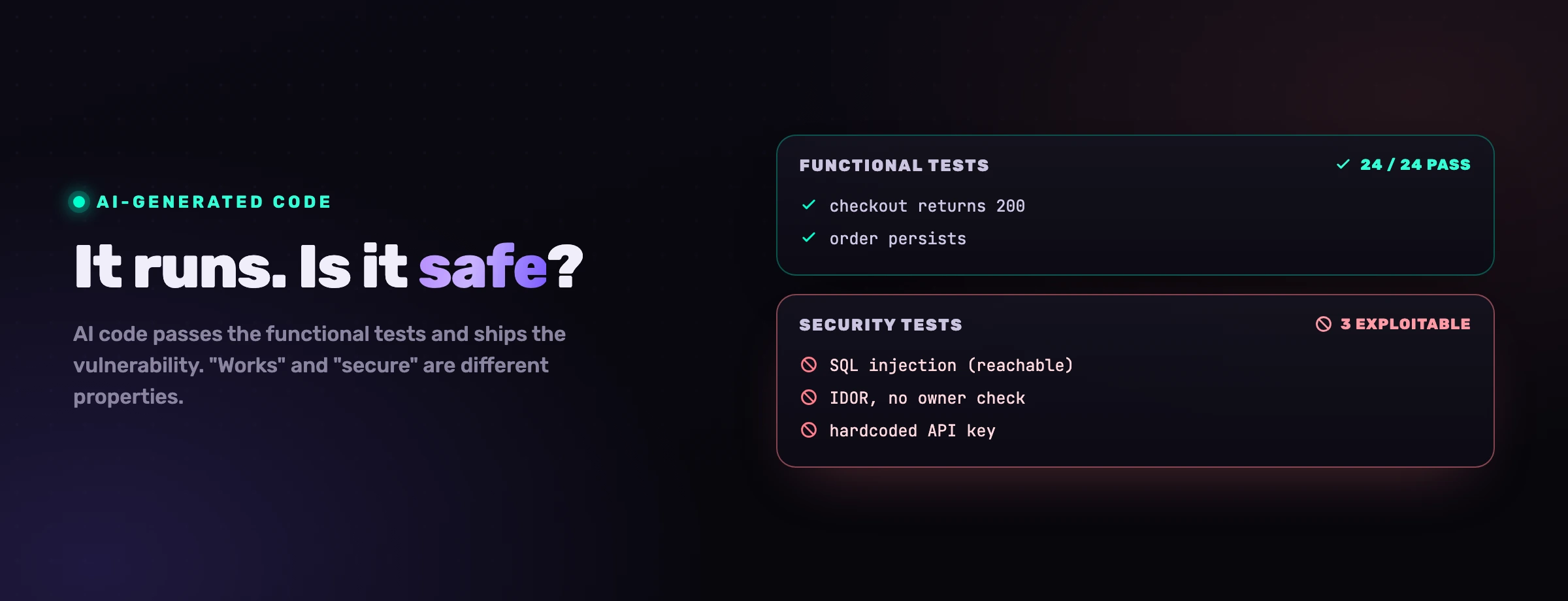
Is AI-generated code safe? It runs, it passes the demo, and it looks like code a competent engineer wrote. That is exactly the problem. "Works" and "secure" are different properties, and an AI agent optimizes hard for the first while a "make it work" prompt never asks for the second. The result, measured repeatedly across independent studies, is that a large share of AI-generated code ships with real vulnerabilities. This guide gives you the direct answer, the 2026 data, the vulnerability classes that scanners and even the code-writing models themselves miss, and what it actually takes to make AI-generated code safe to ship.
Is AI-generated code safe?
No, not by default. AI-generated code is as safe as the controls around it, and most AI-coding setups have no control that acts before the code lands. The model reliably produces code that compiles and passes the happy path; it does not reliably produce code that resists an attacker, because resisting an attacker is about the checks that are absent, and a prompt that asks for a working feature never asks for the missing guard.
The honest framing is that AI-generated code is not categorically dangerous, it is unreviewed code produced at a speed no human can review. A junior developer writes insecure code too, but slowly enough that review keeps pace. An AI agent writes thousands of lines a day, so the gap between "looks right" and "is right" widens faster than anyone can close it. The safety question is therefore really a control question: what catches the vulnerability, and when.
of AI-generated code was vulnerable across MITRE Top-25 security scenarios (NYU, Asleep at the Keyboard)
of AI coding-agent solutions were secure, vs 61% functionally correct (Carnegie Mellon SusVibes)
Broken Access Control, the top risk in the OWASP Top 10, and a class generic scanners rarely catch
Why is so much AI-generated code insecure?
Because the model reproduces the average of its training data, and the average of public code is not secure. Three forces compound, and none of them are fixed by a better model.
First, the corpus problem. The model learned from a huge body of public code that is full of the OWASP staples: string-concatenated SQL, missing authorization checks, weak crypto, inlined secrets. Insecure-by-default is its statistical prior, so it reaches for the common pattern, and the common pattern is frequently the unsafe one.
Second, the absence problem. Security is usually a guard that is present: a bounds check, an ownership check, an escaped input. A model asked for a positive outcome ("add a checkout endpoint") does not add a negative guard nobody requested. The feature works precisely because the missing check does not affect the happy path.
Third, the reader problem, and it is the decisive one. The person prompting can tell whether the feature works. They often cannot tell whether it is safe. That gap, between the author's intent and the reviewer's ability, is the whole security problem, and it is exactly what widens when a non-specialist vibe-codes a feature in a paragraph of intent. We go deeper on this in vibe coding security.
What kinds of vulnerabilities does AI code introduce?
The same ones humans introduce, reproduced faster than review can keep up. These are the classes that recur across every study and every tool, each anchored to where we cover it in depth:
- Injection (CWE-89, CWE-78). Concatenated SQL and shell commands built from user input, because the model learned them from a corpus full of them. See why most SAST findings are noise for why only the reachable ones matter.
- Broken authorization and IDOR (CWE-862, CWE-639). The agent builds the endpoint that returns the record but rarely the check that the caller owns it. This is OWASP's number-one risk and the one scanners see least.
- Hardcoded secrets (CWE-798). Asked for a working integration, the model inlines an API key or password so the code runs on the first try, and it then lives in the repo and every fork.
- Missing input validation (CWE-20). Generated endpoints trust their inputs, which is the quiet enabler of injection and deserialization downstream.
- Insecure deserialization (CWE-502). "Load the saved object" becomes
pickleoryaml.loadon untrusted bytes, turning a stored blob into remote code execution. - Business-logic flaws. The most dangerous class, because no scanner is shaped to catch it: a negative-quantity cart, a coupon that stacks, a refund that skips the ownership check. The code is syntactically perfect and semantically wrong. This is our deep dive on business logic flaws in AI-generated code.
What do scanners, and the models themselves, miss?
Two blind spots matter most, and they are why "just run a scanner" or "ask the model to check its own work" both fall short.
The first is business logic. A static analyzer reasons about code patterns; a business rule ("only the owner may edit this document", "quantity must be positive") lives outside the code, in your domain. There is no tainted input and no dangerous sink to match, just an if statement that was never written, so the scanner reports the file as clean while it is fully exploitable.
The second is the model marking its own homework. Asking the same agent that wrote the code to review it inherits the same blind spots: it does not know your authorization model, it cannot see the other findings around the line, and it is as confident about the insecure version as the secure one. Independent testing bears this out, only a small fraction of AI solutions are secure even when most are functionally correct. A trustworthy check needs outside signal: reachability-aware scanning that follows real data flow, and your own rules loaded as ground truth, not the model's own opinion.
The question is not whether AI writes insecure code, every author does. It is whether anything catches the insecure line before it ships, and at AI speed the only place left to catch it is where the line is written.
Can you trust an AI to fix its own vulnerabilities?
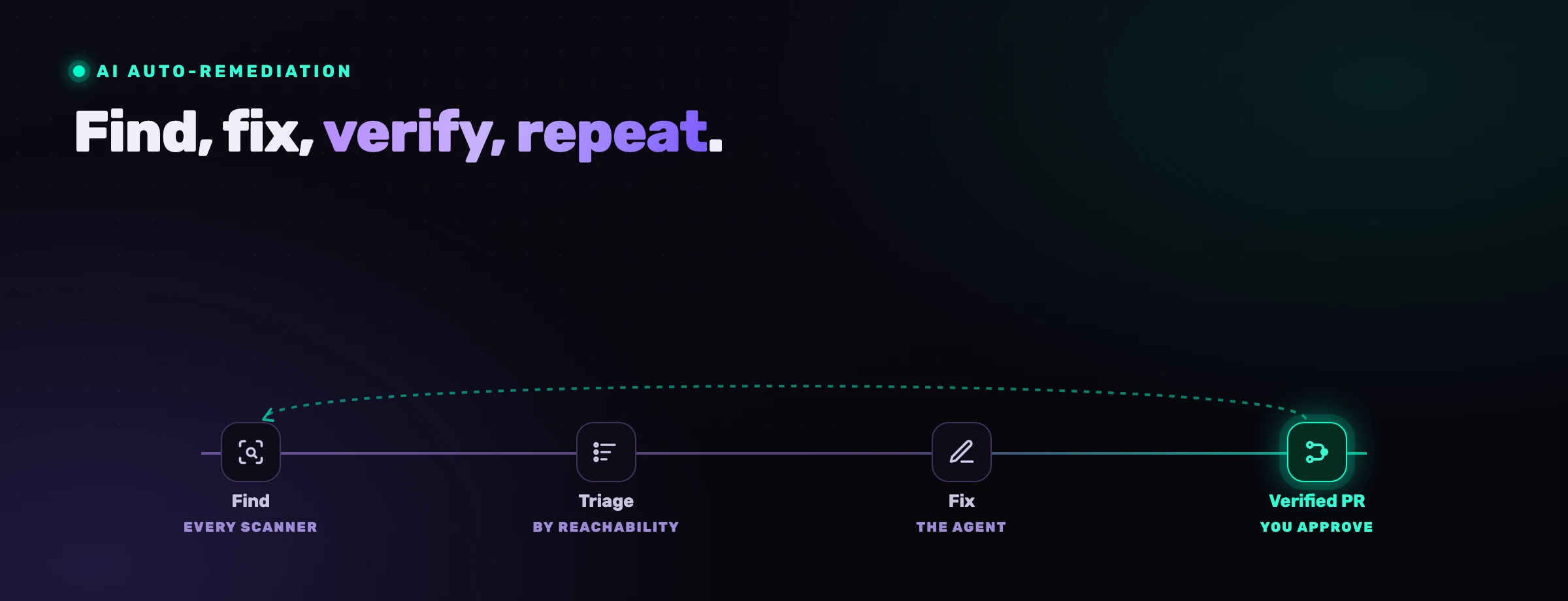
You can trust an AI agent to apply a fix far more than to decide what is a real, reachable vulnerability. The model is strong at rewriting a line once it knows precisely what to change; it is weak at judging whether an issue is exploitable, which is exactly what a mature scanner already computed. So the trustworthy pattern is not "AI, secure my code", it is "give the agent confirmed, reachability-ranked findings plus your rules, let it fix them, and approve every diff". We cover that loop in AI vulnerability remediation and whether an agent can find and fix vulnerabilities automatically.
How do you make AI-generated code safe?
You make it safe by moving the control to the moment the code is written, instead of trusting the model or waiting for a scanner after merge. Three moves, in order of leverage:
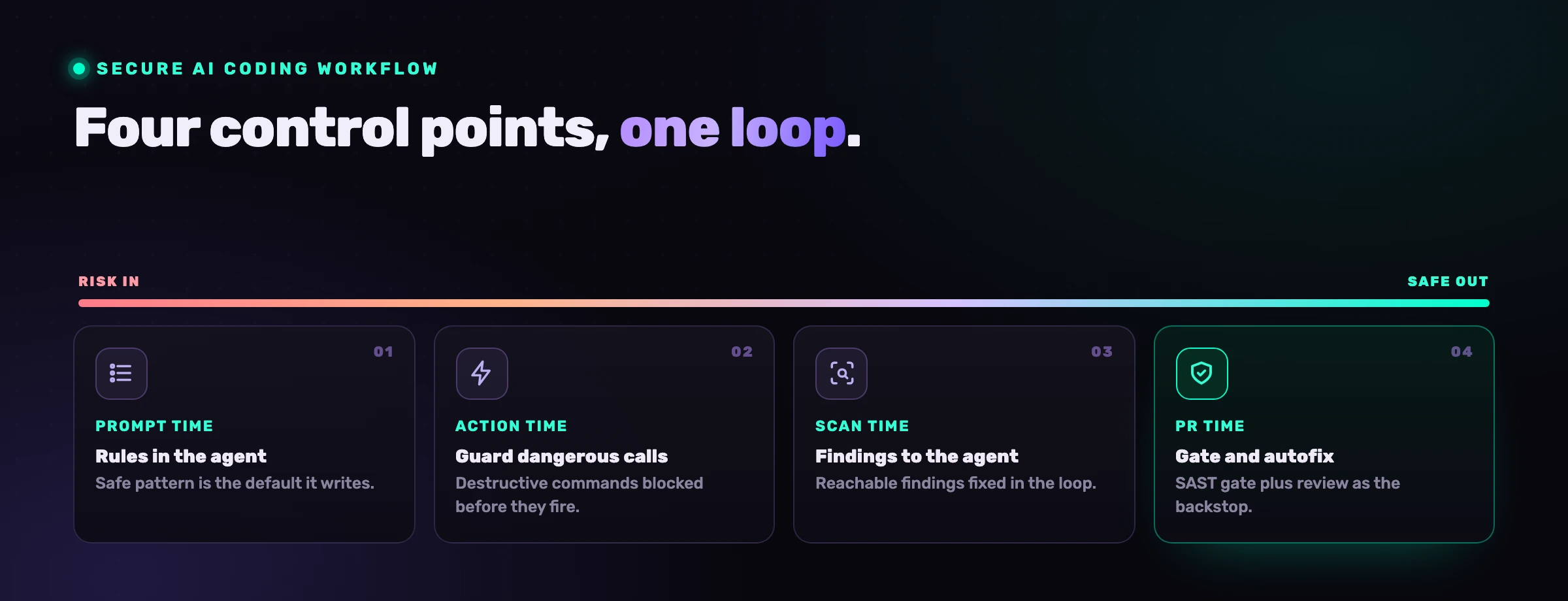
- Govern at generation time. Load your security and business rules into the agent before each edit, so the safe pattern is the default it reaches for. The vulnerability that is never written needs no triage. This is the core idea of AI coding agent security.
- Scan continuously and feed the findings back to the agent. Keep reachability-aware SAST, SCA, secrets, IaC and the rest running, and put their confirmed findings in the agent's hands so it remediates the real ones in the loop.
- Keep CI and human review as the backstop. A SAST gate on every pull request and a human approving diffs catch what slips. They are necessary, but at AI speed they cannot be the only line.
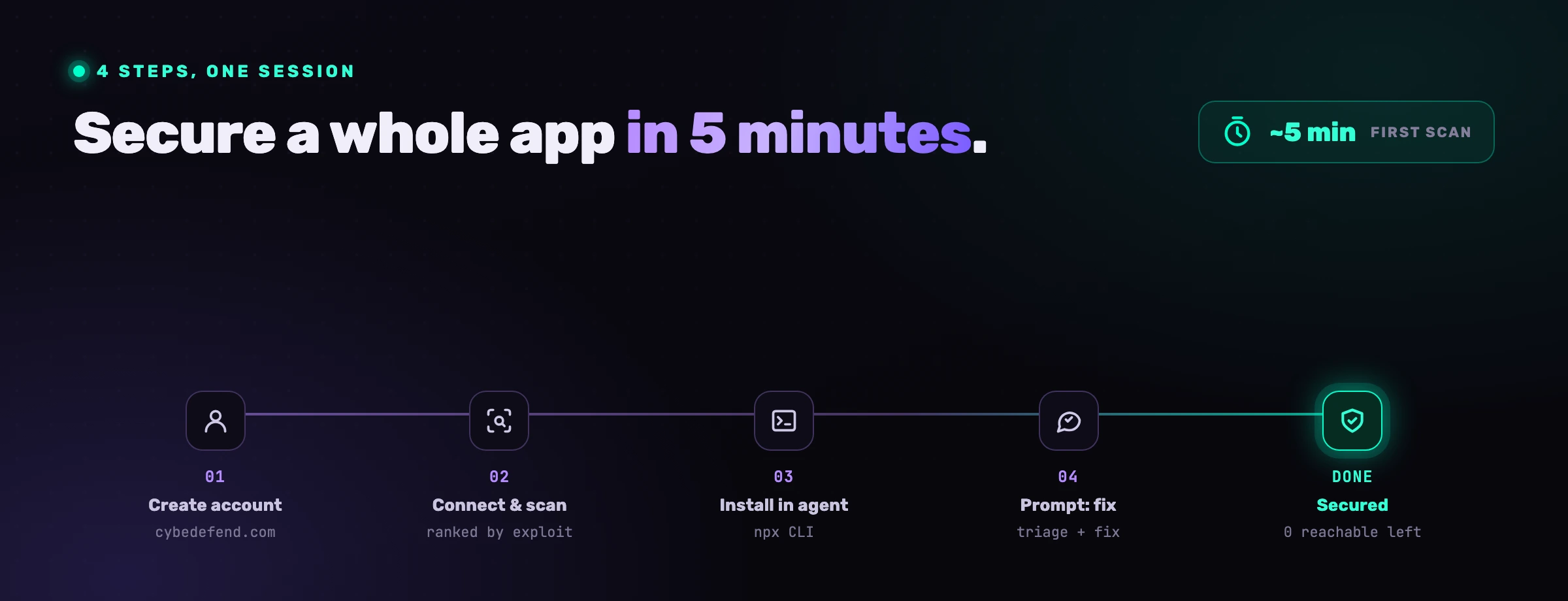
The full hands-on version is how to add security to your AI coding workflow and how to secure a whole app in five minutes.
VibeDefend is the layer that does the first two. It is a free npm CLI that installs in seconds and wires Claude Code, Cursor, Windsurf, OpenAI Codex and VS Code Copilot into four governance layers inside the agent loop.
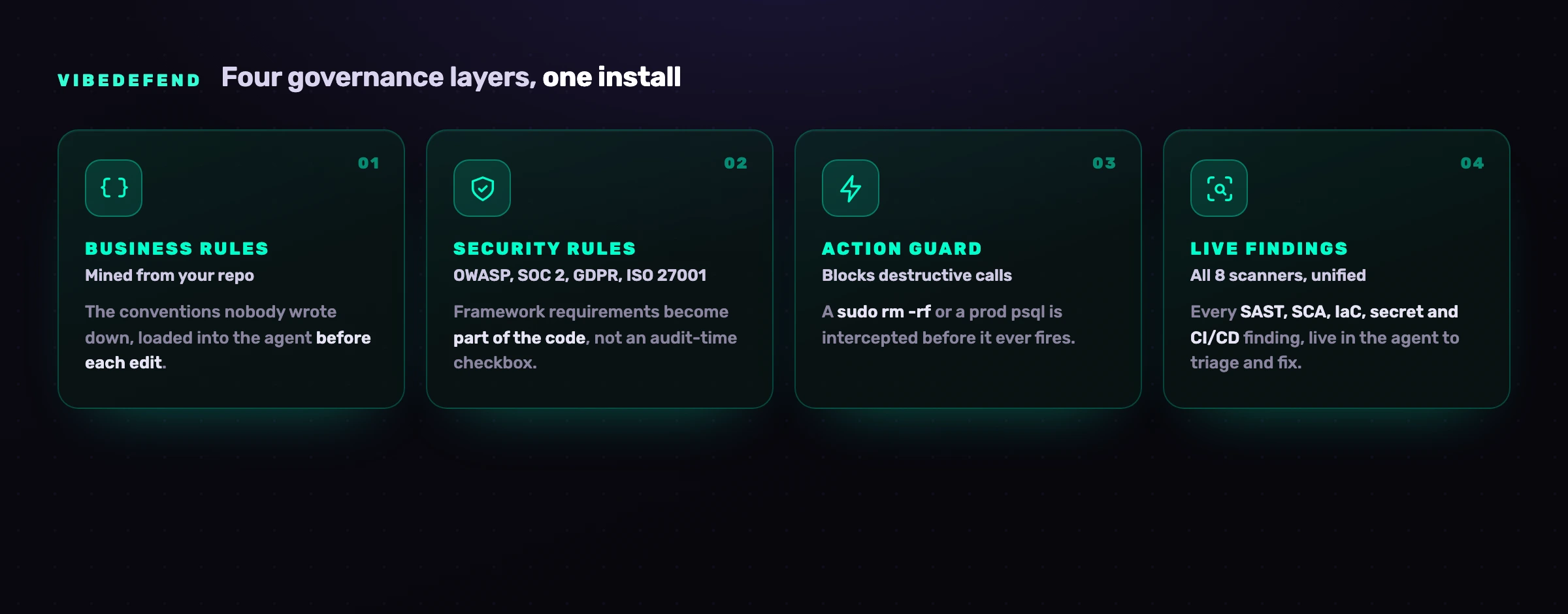
Three layers govern what the agent writes, Business Rules mined from your repo, Security Rules from OWASP, SOC 2, GDPR and ISO 27001, and an Action Guard that blocks destructive calls. The fourth, Live Findings, wires the agent into CybeDefend's full AppSec platform, with its scanners running continuously with every finding live in the agent's context, so the agent does not only write safer code, it fixes the vulnerabilities you already have. Nothing about your code crosses the wire; only structured governance metadata does, on EU or US regions kept physically separate.
Frequently asked questions
Is AI-generated code safe?
Not by default. AI-generated code reliably runs and passes the happy path, but independent testing repeatedly finds a large share of it insecure, roughly 40% vulnerable in the NYU "Asleep at the Keyboard" study, and only about 10% of AI coding-agent solutions secure in Carnegie Mellon's SusVibes benchmark even though most were functionally correct. It becomes safe when you add a control that acts where the code is written and keep human review and CI scanning behind it.
Is it safe to deploy AI-generated code to production?
Only after it is reviewed and scanned the way any code should be, and ideally after it was governed as it was written. Deploying AI code straight from "it works" is risky because the flaws (missing authorization, injection, hardcoded secrets, business-logic errors) do not affect the happy path and so survive a functional test. Gate it with reachability-aware SAST in CI, human review of security-sensitive paths, and a prompt-time control so the safe version is written first.
Why is AI-generated code insecure if the model is so capable?
Because capability at producing working code is not the same as producing secure code. The model reproduces the insecure patterns common in its public training data, security is usually a guard that must be added rather than a positive outcome a prompt requests, and the person prompting often cannot evaluate whether the result is safe. None of these are fixed by a smarter model; they are fixed by a control around the model.
Can I just ask the AI to check its own code for vulnerabilities?
It helps a little and is not sufficient. The same model that wrote the code shares its blind spots: it does not know your authorization model or tenant boundary, it cannot see the other findings around the line, and it is equally confident about the insecure and secure versions. Trustworthy checking needs outside signal, reachability-aware scanning and your own rules as ground truth, not the model's self-assessment.
What are the most common vulnerabilities in AI-generated code?
Injection (CWE-89, CWE-78), broken authorization and IDOR (CWE-862, CWE-639), hardcoded secrets (CWE-798), missing input validation (CWE-20), insecure deserialization (CWE-502), and business-logic flaws. The first five are detectable by good scanners when you filter for reachability; the last, business logic, is the dangerous one because no scanner is shaped to catch a syntactically perfect, semantically wrong rule.
How do I make AI-generated code safe?
Move the control to generation time: load your security and business rules into the agent so it writes the safe pattern first, scan continuously and feed the confirmed findings back to the agent to remediate, and keep a CI SAST gate plus human review as the backstop. Trusting the model to self-police, or relying only on a post-merge scan that arrives after the agent has moved on, is what leaves the gap.